
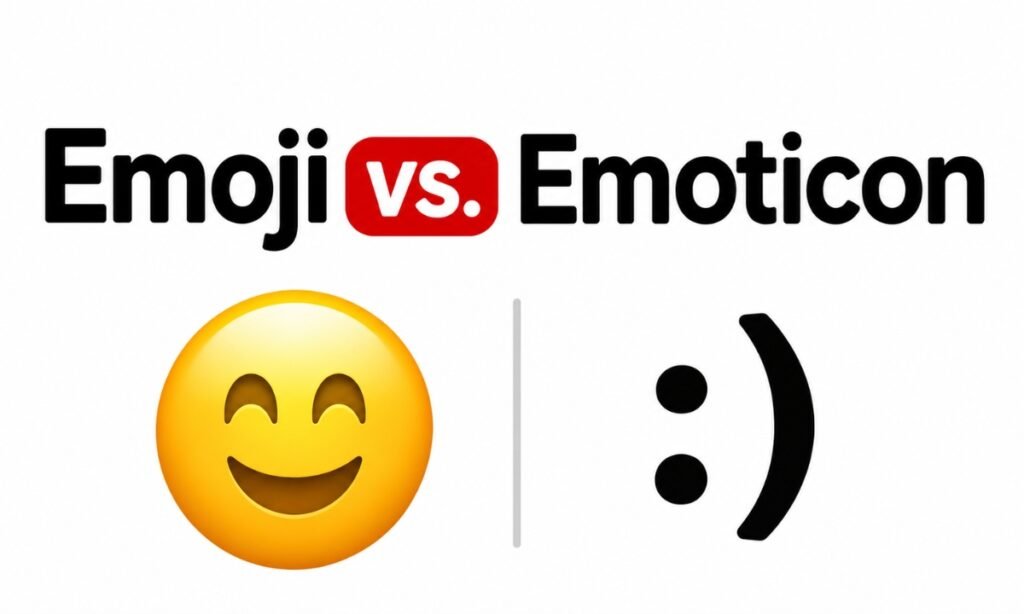
Ever wondered why some people type :) while others send 😊 to express the same feeling?
Both help us show emotions in text messages, but an emoji and an emoticon aren’t exactly the same thing.
The main difference comes down to how they’re created, and once you see a few examples, it’s easy to tell them apart.
What’s the Difference Between Emoji and Emoticon?
An emoticon is a facial expression made from keyboard characters, while an emoji is a pictorial symbol used in digital communication.
For example, :) is an emoticon because it uses a colon and a closing parenthesis to represent a smiling face.
On the other hand, 😊 is an emoji because it’s a graphical symbol that your device displays as a smiling face.
Here’s a quick comparison:
| Feature | Emoticon | Emoji |
|---|---|---|
| Example | :) | 😊 |
| Appearance | Text-based | Usually graphical |
| Created using | Letters and punctuation | Unicode characters or sequences |
| Represents | Mostly emotions and gestures | Emotions, objects, animals, activities, and more |
| How to type | Combine keyboard characters | Select from an emoji keyboard or picker |
| Display | Usually remains text | Appearance varies across platforms |
The Unicode Consortium’s explanation of emoji and emoticons confirms this distinction between character-based expressions and pictographic symbols.
What Is an Emoticon?
The word emoticon comes from combining “emotion” and “icon.” It describes a facial expression or gesture created by arranging text characters.
Some familiar examples include:
:)– Happy:(– Sad;)– Winking:P– Sticking out tongue:D– Big smile:O– Surprised
Most traditional Western emoticons are meant to be viewed sideways. If you tilt your head to the left, :-) resembles a smiling face.
Emoticons became popular in early computer communication, long before smartphones introduced colorful emoji keyboards.
In 1982, computer scientist Scott Fahlman suggested using :-) and :-( to help readers distinguish jokes from serious messages on a Carnegie Mellon University bulletin board.
You can see his original suggestion in Carnegie Mellon’s history of the smiley emoticon.
Not every emoticon is sideways, though. Japanese-style expressions called kaomoji, such as (^_^) and (T_T), are designed to be read upright.
What Is an Emoji?
An emoji is a digital pictograph that represents an emotion, object, activity, or idea.
Unlike emoticons, which you create by combining text characters, emoji are standardized through Unicode and displayed using graphical designs.
For example:
- 😂 – Face with tears of joy
- ❤️ – Red heart
- 👍 – Thumbs up
- 🎉 – Party popper
- 🐱 – Cat face
- 🍕 – Pizza
Notice that emoji aren’t limited to facial expressions. You can use them to represent food, animals, weather, celebrations, and everyday objects.
Another interesting difference is that the same emoji may look slightly different on an iPhone, Android phone, or Windows computer.
That’s because each platform can use its own artwork to display the underlying Unicode characters.
The Unicode Emoji Standard explains how these characters and sequences are defined for use across digital platforms.
Emoji vs. Emoticon Examples
Sometimes the easiest way to understand the difference is to compare how the same feeling looks in both formats.
| Emotion | Emoticon | Emoji |
|---|---|---|
| Happy | :) | 🙂 |
| Sad | :( | 🙁 |
| Laughing | :D | 😃 |
| Winking | ;) | 😉 |
| Surprised | :O | 😮 |
| Playful | :P | 😛 |
Both versions communicate similar feelings, but they create a different visual impression.
For example, sending :) can feel simple and understated, while choosing 😃 adds a more visually expressive reaction.
Some messaging apps even automatically replace typed emoticons with matching emoji. So you might type :) and see a graphical smile appear instead.
When Should You Use Emoji or Emoticons?
There’s no strict rule about which one is better. It depends on the conversation and how you want your message to feel.
Use emoticons when you prefer simple text expressions, want a more understated reaction, or are communicating somewhere that doesn’t display emoji properly.
Use emoji when you want to express something visually, react quickly to a message, or represent objects and activities that aren’t easy to show with punctuation.
For example, writing “Good luck! :)” works perfectly well in a casual message.
But if you’re congratulating someone, “Congratulations! 🎉” immediately adds a celebratory touch.
Just keep your audience in mind. A playful emoji may suit a conversation with friends, while a simple text message might feel more appropriate in certain professional situations.
FAQs
Is a Smiley Face an Emoji or Emoticon?
It can be either. A smiley created with keyboard characters, such as :), is an emoticon. A graphical smiling face like 😊 is an emoji. The term “smiley” can refer to both.
Are Kaomoji Considered Emoticons?
Yes. Kaomoji are Japanese-style text emoticons that use characters to create upright expressions, such as (^_^). They’re different from traditional Western emoticons because you don’t need to view them sideways.
Conclusion
The difference between emoji and emoticon is simple: emoticons use text characters to create expressions, while emoji use graphical symbols.
Both make digital conversations more expressive, and neither is necessarily better than the other.
Whether you prefer a classic :) or a colorful 😊, you’re using a small symbol to communicate something that words alone might not fully capture.